

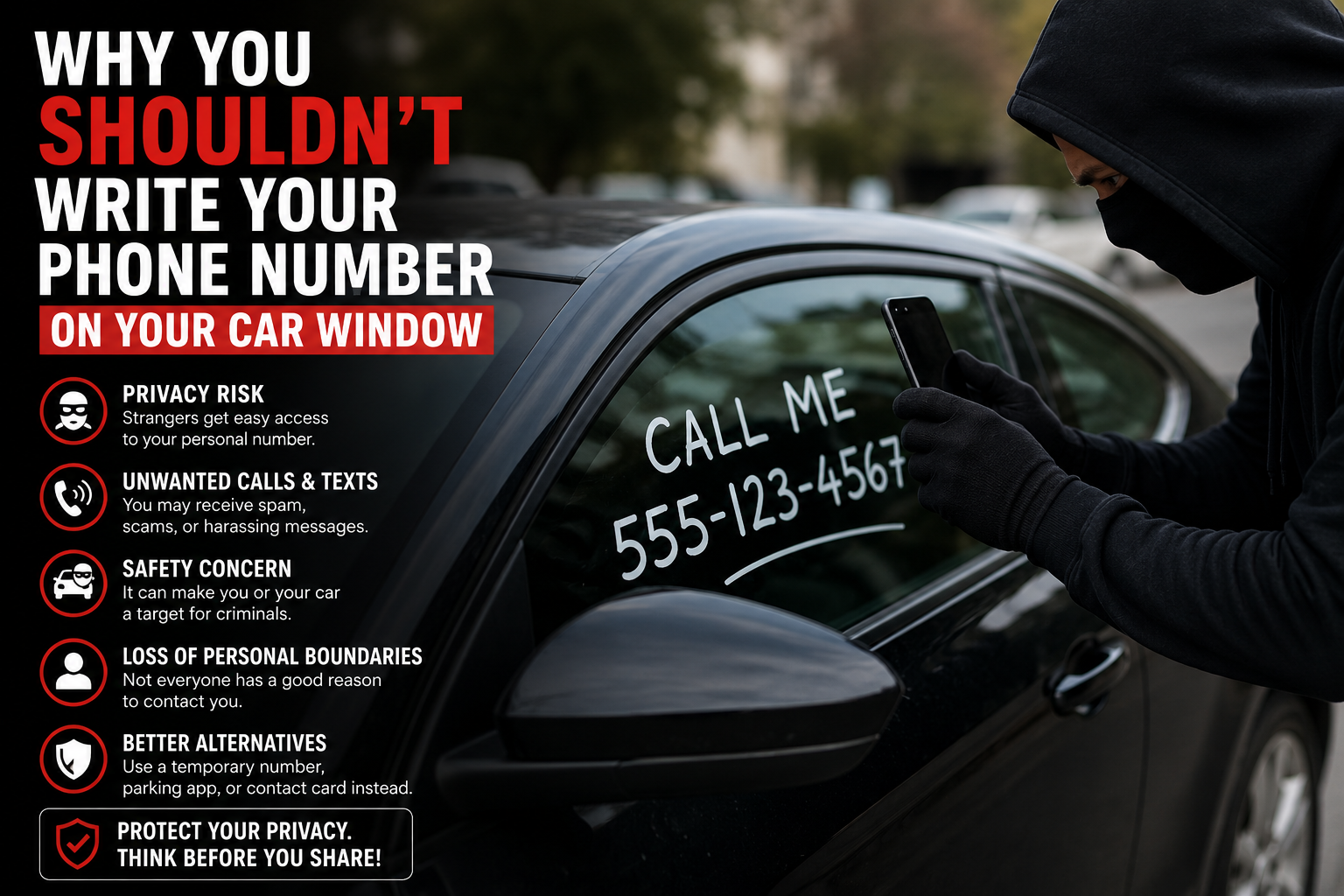
Walk through any parking lot in Delhi, Mumbai, Bengaluru, or Jaipur and you'll spot the same thing on dozens of windshields: a mobile number, scrawled in marker or printed on a sticker, sitting right below the wiper blade. The intention is good — if you're blocking someone in, if your lights are still on, if there's an emergency, you want to be reachable. But that small act of convenience quietly creates a privacy problem most car owners never think twice about.
Your number becomes public the moment it goes on glass
A phone number on your car isn't shared with "whoever needs it." It's shared with everyone. Every person who parks near your car, walks past it, or photographs the lot sees your number — not just the one person who might genuinely need to reach you about a blocked exit. There's no way to control who reads it, when, or why.
That distinction matters more than it sounds. A number on a form, an app, or a business card is at least handed to someone deliberately. A number on your windshield is broadcast to an anonymous crowd, indefinitely, for as long as the sticker or ink survives.
It's an easy target for number harvesting
Telemarketers, spam callers, and scam operations don't need to hack anything to build a list — they just need someone willing to walk a parking lot and note down numbers, or a tout who's paid per number collected. Handwritten notes and printed stickers on cars are an easy, low-effort source. Once your number is in one of these lists, it tends to get resold, and the calls don't stop with one telemarketer — they multiply.
This isn't a small problem in India right now. TRAI's own enforcement data shows the scale of it: in just the first quarter of FY 2026-27, telecom operators' AI systems flagged over 24 billion suspected spam calls and messages, and TRAI took action against more than 1.83 lakh telecom resources in that quarter alone. Regulators are fighting a genuinely large, active problem — and a publicly visible phone number is one of the easiest ways to end up feeding it.
It exposes more than just "your number"
A phone number is rarely just a phone number anymore. It's often linked to WhatsApp (with your display photo and status visible to anyone who saves it), UPI apps, food delivery accounts, and increasingly, digital identity checks. Someone with bad intent doesn't need to call you to cause a problem — they can try your number on WhatsApp, attempt OTP-based social engineering, or simply use it to figure out who you are and where your car is regularly parked.
For women, for people who travel alone frequently, or for anyone who's dealt with an unwanted caller before, this risk isn't hypothetical — it's a genuine reason many people say they've stopped displaying their number altogether, even though it means losing the "in case of emergency" benefit.
The real tradeoff: reachability vs. exposure
The honest reason people still write their number on the glass is that the alternative — not being reachable at all — feels worse. Nobody wants their car towed, or to come back to a scratched bumper with no way for the other driver to have reached them. That's a legitimate need. The problem was never "should people be able to reach you," it's that a raw phone number is a bad tool for the job: it's permanent, unfiltered, and impossible to revoke once it's out there.
A better way to stay reachable
This is exactly the gap anonymous contact stickers were built to close. A QR-based sticker like Zapo lets anyone who scans it call or message you about your vehicle — through a masked number that never gets shown to them, and that you can deactivate any time. You get the same "someone can always reach me" benefit, without a permanent, publicly readable number sitting on your windshield for anyone to note down.
If you're still relying on a handwritten number or a printed sticker with your real digits on it, it's worth the two minutes it takes to switch. You lose nothing in reachability, and you get your number back to yourself.
Ready to stop handing your number to every stranger in the parking lot? Get your Zapo Q sticker and start taking calls without ever revealing your real number.