

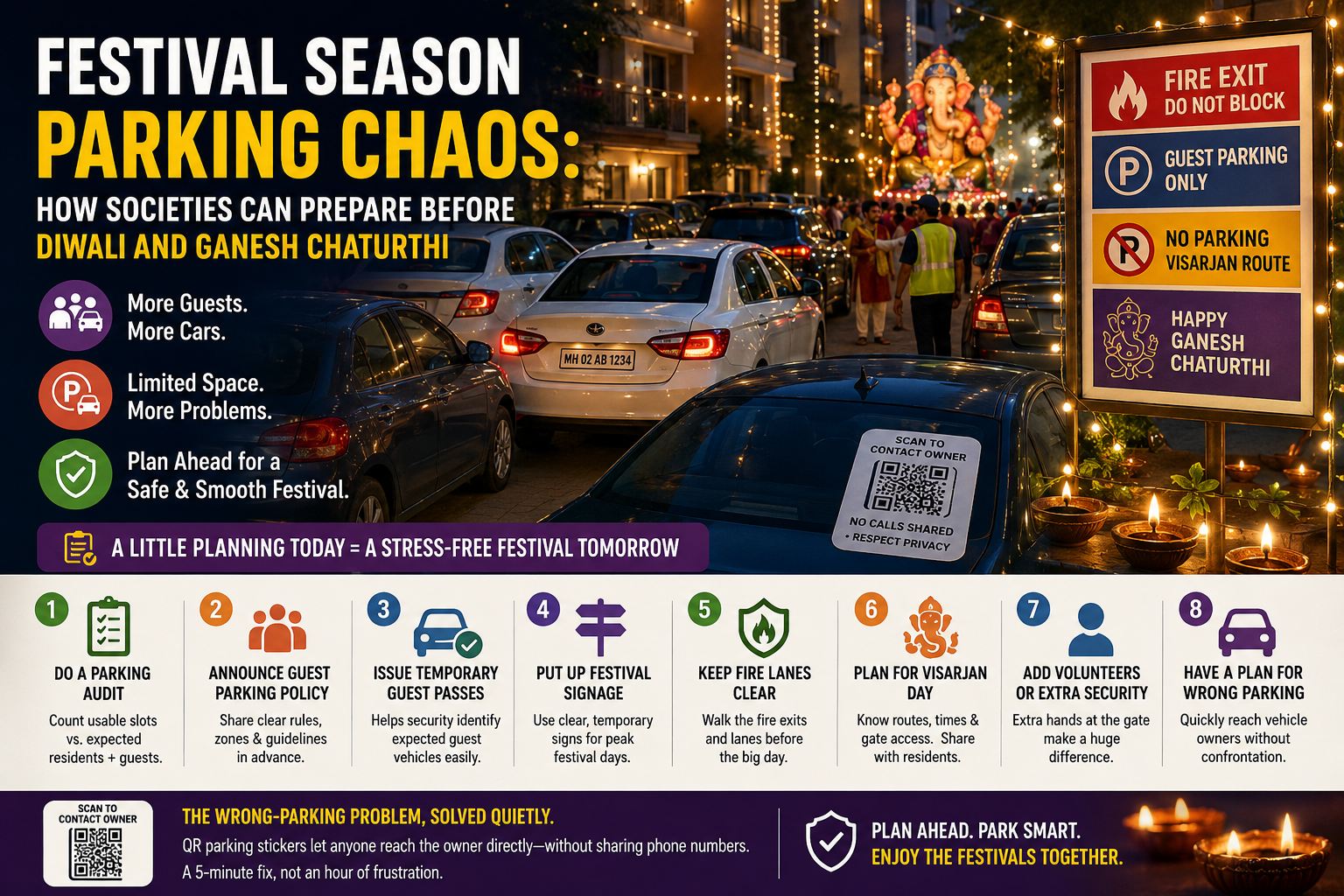
Every housing society knows the feeling. The week before Diwali, or the ten days building up to Ganesh Chaturthi visarjan, the parking lot that usually has a few empty slots suddenly doesn't. Guests are arriving for pujas, relatives are staying over, delivery vans are dropping off decorations and sweets in bulk, and every resident who normally parks on the street outside is now trying to squeeze into the society compound instead.
By the time the actual festival day arrives, most societies are firefighting: cars blocking the fire exit, two-wheelers parked across walking paths, an unfamiliar car blocking someone in with no way to reach the owner. None of this is new — but almost none of it gets planned for in advance either. A little preparation two to three weeks out saves the parking committee a very stressful festival week.
Why festival parking is a different problem than everyday parking
Regular day-to-day parking chaos is about volume — too many vehicles, not enough marked slots. Festival parking chaos is about unpredictability: a sudden spike in unfamiliar vehicles (guests, caterers, decorators, priests, delivery trucks), all arriving and leaving on a compressed timeline, often without anyone in the society knowing who they belong to.
That unpredictability is what causes the specific problems that show up every festival season:
- Guest and visitor cars double-parked because there's no clear guest parking zone
- Fire exits and emergency lanes blocked by overflow parking — a real risk during Diwali specifically, given how many societies also have crackers and open flames nearby
- Ganesh Chaturthi visarjan processions closing off approach roads, catching residents off guard on the exact day they most need to get in or out
- No way to quickly reach the owner of an unfamiliar, badly parked vehicle — so it just sits there, blocking someone, until the festival is over
A prep checklist RWAs can start using today
1. Do a parking audit before the festival rush starts. Walk the compound and count actual usable slots versus how many residents plus expected guests will need. Most societies underestimate this until the week it actually matters.
2. Announce a clear guest parking policy in advance. Decide where visitor vehicles should go — a designated overflow area, a specific row, a nearby ground — and communicate it on the notice board and the resident WhatsApp group at least a week before the festival, not the day of.
3. Issue temporary guest parking passes. A simple printed pass (or a WhatsApp broadcast with vehicle numbers residents expect) lets security tell a genuine guest's car apart from a random one at a glance, without confrontation at the gate.
4. Put up signage for the festival period specifically. "Fire Exit — Do Not Block," "Guest Parking Only," "No Parking — Visarjan Route" — temporary signage for the one or two peak days works better than relying on people remembering a WhatsApp message from last week.
5. Keep fire lanes and exits physically clear. This matters every day, but it matters more during Diwali, when crackers, diyas, and decorative lighting are concentrated near the same parking areas. Walk the fire lane the morning of the festival, not just the week before.
6. Plan specifically for Ganesh Chaturthi visarjan day. Processions can close off approach roads for hours with little warning to individual residents. If your society is anywhere near a common visarjan route, tell residents which gate to use and roughly what time to expect road closures, based on the local procession schedule.
7. Rope in a few volunteers or extra security for peak days. One or two extra people directing guest traffic at the gate for the two or three busiest hours prevents most of the "everyone parks wherever they find space" problem before it starts.
8. Have a plan for wrongly parked vehicles — before you need it. This is the one that catches most societies out. A car blocks another car in, or blocks the fire exit, and there's genuinely no fast, non-confrontational way to reach whoever owns it. Shouting across the compound or knocking on doors doesn't scale during a festival, when half the society has guests staying over.
The wrong-parking problem, solved quietly
That last point is exactly the gap a QR parking sticker closes. Every sticker on a resident's vehicle carries a scannable code — scan it, and whoever's blocked can reach the owner directly, without anyone's phone number ever being shared. No confrontation at the gate, no security guard going door to door during the one week they're already stretched thin, no note left on a windshield that never gets seen in time.
It's a small thing on a normal Tuesday. During the ten days of Ganesh Chaturthi, or the guest-heavy week around Diwali, it's the difference between a five-minute fix and an hour of frustration for everyone involved — including whoever's car is doing the blocking, who usually has no idea they're causing a problem in the first place.
Societies that put this in place before the festival season, not during it, tend to have a noticeably calmer parking committee by the time the lights come down and the last guest car has left.